Tuesday, December 1, 2009
Census of Marine Life
Worth watching full screen, high definition, if you can.
See more at: www.coml.org
Image Gallery: www.coml.org/imagegallery/
Video Gallery: www.coml.org/video/
Wednesday, November 25, 2009

Tree Seeds

Photographed with a Nikon Coolpix L100 Digital Camera
Photo ©2009 Universe 6
Monday, November 9, 2009
Saturday, November 7, 2009
WMAP: Getting to Know Your Universe
Coming this Christmas: An inflatable WMAP beachball - available at your local Walmart (made in China).
The Hudson Palisades and Pangea

The Palisades, Hudson River
It is an intriguing idea that the Hudson Palisades in New York and New Jersey were once physically attached to the coast of West Africa.
About 200 MYA New York's Manhattan Island and the now tree-hidden Palisades on the New Jersey shore of the Hudson River were opposite the Cap Bojador-Cap Blanc regions of West Africa... Between 220 and 200 MYA innumerable rift valleys had formed from eastern Greenland to Guinea in West Africa at the start of the breakup of Pangea. Along what is now the East Coast of North America, the "Newark Rift system" stretched from the Carolinas to Nova Scotia. When the supercontinent finally rifted apart between the East Coast and Northwest Africa, it separated along the approximate line of a previous suture. Water flooded into the breach from the Tethys Ocean in the east to form the proto-Central Atlantic, from Gibraltar to the Bahamas. As seafloor spreading took hold, the tension pulling the neighboring margins apart eased, and the now-inactive rift valleys were filled by lakes and sediments. During the active lifetime of the East Coast rifts basalt flooded parts of what are now the states of Connecticut and New Jersey. Some magma that could not reach the surface intruded beneath existing rocks to form volcanic "sills" - so named because of their elongated, horizontal windowsill form. One such sill has since been uplifted and uncovered by erosion to form a high escarpment, the Palisades cliffs of the Hudson River - a memorial to the origins of Pangea's disintegration.

Pangea breakup animation (Source: USGS/Wikipedia)
Monday, October 19, 2009
New Planets Discovered
Link: 32 planets discovered outside solar system (CNN article).
I thought this was newsworthy. How often do we find a new planet? Not often! Makes you wonder if they are a dime-a-dozen. Maybe there are so many out there that eventually every person on earth can claim one as his or her own...
Monday, October 12, 2009
Monday, August 31, 2009
A Fossil Story
 Photo ©2009 Universe 6
On a recent trip to the local Goodwill in search of neglected treasures, Sandy found a bag of 11 fossils, each packaged separately with an identification card. It was an amazing find. Included were a fossil fish (Gosiutichthys, 40 million years old), a trilobite (Elrathia Kingi, 550 million years old), a shark tooth (Miocene Period), fossil brachiopods (325 million years old), and a small fossil dinosaur bone (Jurassic period, 150 million years old). Since we were fishing these out of the bottom of the bins at the outlet store at the end of the day, it was highly probable that (had we not saved them) they would have ended up in a dumpster with all of the other junk that did not sell. The irony of this struck me. Half a billion years ago, a Washington-quarter-size trilobite lives a simple life, then dies and is covered by sediment in an area we now call Utah. Its body becomes fossilized and remains hidden for 550 million years. Geological transformations thrust it to the surface, then a fossil hunter stumbles across it, extracts and cleans it, packages and sells it. It is purchased and taken home, admired, and stored away for a few years in a shoebox on the top shelf of a closet. Then, under circumstances which we will never know, this treasure is discarded - given to a local charity. It sits for sale in the thrift store, but no one is interested. It is considered unremarkable, sitting on the display shelf not too far from the bright green discount shoes, the rap CDs, the hair dryers made in China, the kitty print chemises made in Indonesia, and the big-eye art prints. After a few months an unenlightened and impatient employee sends it to the thrift store graveyard (the outlet store). Again it sits neglected. It shuffles to the bottom of the bin, buried again (this time briefly) by an ugly vacuum cleaner, a filthy child's toy, a broken bottle of shampoo, a stained Calvin Klein bag. Bratz dolls, with grossly oversized eyes, stare blankly at their neighbor the trilobite. Barbie, naked and with ratted hair, lies nearby, equally catatonic. Then, late in the day, a weary shopper digs to the bottom of the bin in search of the small remaining treasures. Barbie is shoved aside and the trilobite is again unearthed, along with a few other fossils which were also recently buried Utah, Wyoming, and California. And what if this weary shopper had missed them, glanced instead at the marbles nearby or the (ironically) small plastic toy dinosaurs? Closing time would have come, the bins and their neglected contents would be rolled into the back warehouse. The following morning the bins would be emptied into a large dumpster - the beginning of the end. Inevitably, the local garbage carrier would come, empty the dumpster into a truck and transport it to a landfill. There, somewhere in the immense pile, the tiny fossils would find themselves back underground. Compacted, in close proximity to the broken vacuum cleaner, the 8-track tape, the naked Barbie, the water-stained diet book, and the precious stuffed toy dog, the fossils would settle into their new place of rest. Unlikely to be disturbed for many years, they would remain in this perverse new environment - a graveyard of overproduction and mass consumption. And for how long? For another 500 million years? Let's just say that it is, indeed, another half-billion years before geological forces once again force the trilobite fossil to the bright surface. Since the death of the small animal, it has remained underground for a billion years. A thousand million years of darkness. Except for a few years when it was briefly resurrected in the 1990s. Yet that time of air and light was brief. A mere fraction of a second in that billion year period. Yet, because a woman with an eye for treasure saved it from its fate, it has a more hopeful future...
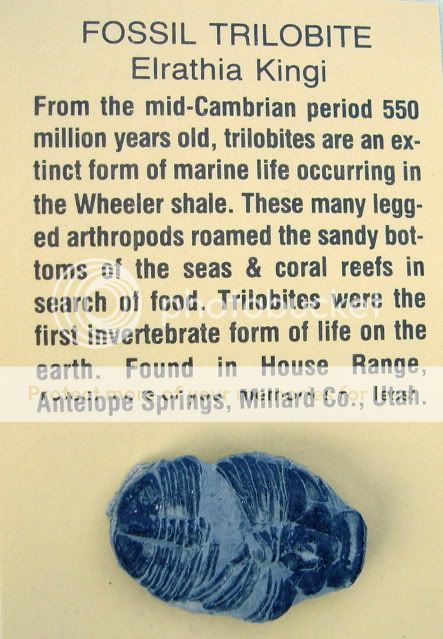
FOSSIL TRILOBITE (Elrathia Kingi) -- From the mid-Cambrian period 550 million years old, trilobites are an extinct form of marine life occurring in the Wheeler shale. These many legged arthropods roamed the sandy bottoms of the seas and coral reefs in search of food. Trilobites were the first invertebrate form of life on the earth. Found in House Range, Antelope Springs, Millard Co., Utah.
Monday, July 20, 2009
The 40th Anniversary of the Moon Landing
It is reported that around 20% of Americans believe the Apollo moon landing was a hoax. Somehow this doesn't seem surprising considering that probably at least that many believe that the earth is only 4000 years old and that man and the dinosaurs co-existed. The degree of scientific illiteracy in this country is alarming.
I never thought that there was anything wrong with cracking open a book on mathematics for physics and reading just for the sake of reading. Is it difficult? Yes, but the knowledge gained is rewarding. Just because a person is beyond the age of a typical college student does not mean that it is too late to learn. Substitute one hour of television or online social networking with one hour of reading a good science book. One hour a day is all it takes. Repeat this every day for the rest of your life. Pick a somewhat specific subject so that you can dig deeply into one area without skipping around. Understand that you will not pick up the subject instantly -- it takes time.
I never thought that there was anything wrong with cracking open a book on mathematics for physics and reading just for the sake of reading. Is it difficult? Yes, but the knowledge gained is rewarding. Just because a person is beyond the age of a typical college student does not mean that it is too late to learn. Substitute one hour of television or online social networking with one hour of reading a good science book. One hour a day is all it takes. Repeat this every day for the rest of your life. Pick a somewhat specific subject so that you can dig deeply into one area without skipping around. Understand that you will not pick up the subject instantly -- it takes time.
Wednesday, June 3, 2009
Astronomy iPod app from naturalguides.com
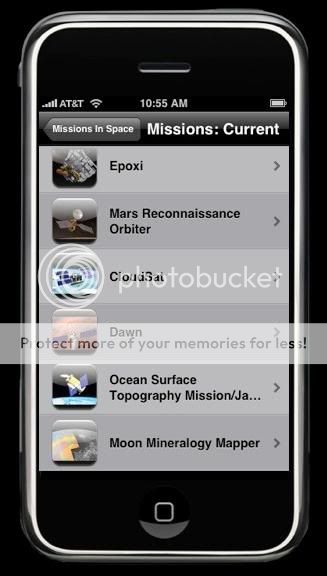
Your iPhone can do just about anything, so why not astronomy too? Astronomy Guide is a new app from naturalguides.com. The application can be downloaded for only $2.99.
Sunday, May 31, 2009
Can you trust your own mind?

(Click on picture to enlarge it.)
Look at the squares marked 'A' and 'B'. Do they appear to be different colors? If someone told you that both squares were, in fact, the SAME color would you believe it? At first, I thought it was a practical joke, something that only appeared to be a classic optical illusion. It was clear to me that it was a checkerboard tiled with squares of obviously different colors. The colors were not even remotely close to being the same. Isn't that what you see? But I knew that the green cylinder was not there arbitrarily. It serves a very important purpose. Do you know what that is? Still not convinced? Ok, do this: Get a piece of paper (preferably dark) and punch two small holes in it which are as far apart as the letters 'A' and 'B' on your screen. The holes should be big enough so that you can see the letters but nothing else. Hold the paper up to the screen and align it so that the letters can be seen through the holes. Now press the SEND FAX key on your keyboard. (Sorry, just kidding.) Seriously, now look at the colors of the 'A' and 'B' squares. Are they different now? What changed, the image or your perception of the image?
This demonstration is an excellent reminder that our perception of the universe may not always be aligned with the truth (or reality). Before the trick of this example is explained, most people probably would not question what their eyes were telling them. In the everyday world it would be almost impossible to function if we had constant doubts about the reality of everything before our eyes. The mind evolved to accept (most of the time) the perception of a situation without question. Early man could not afford hesitate in thought when hunting animals for food.
It is a humbling experience to be fooled when we think we are smart. What else has fooled us...? If no one tells us, how will we ever know? The scientific method used today was established for that very reason. Always good to have another set of eyeballs looking over your shoulder... just in case.
Friday, May 29, 2009
Discover the Universe at Academic Earth
This new website was just launched and gives you quick access to many video lectures from America's best universities. Subjects include astronomy, biology, chemistry, computer science, engineering, mathematics, physics, philosophy, and much more! Link:
http://www.academicearth.org/
I have sampled a few of the computer science lectures (my field) from Harvard and found them informative and entertaining. Example: Introduction to Computer Science (David J. Malan)
Tuesday, May 19, 2009
47 Million Year Old Fossil Found
Is it our ancestor? Tiny creature is named Darwinius masillae. Full Story on Yahoo! News: 47-Million-Year-Old Fossil.
Thursday, May 14, 2009
Origins of Life
From Hulu.com (Length 39:14, Click upper right corner for full screen)
This film by Gérald Calderon and Bernhard Elsner discusses early life on earth. Not a lot of hard science but features some great marine life photography! One fascinating idea mentioned here is that crystals may have played a critical role in the formation of early life. Read more here: http://www.dna.caltech.edu/Papers/dna-crystal-evolution.pdf
Sunday, May 10, 2009
A Day for Mothers
This is a brief entry to honor my mother (M.) who gave me life. She is 70 and going strong. An intelligent, loving, and honorable person who is but one in a robust and ancient line... Thanks, Mom.
Saturday, May 9, 2009
Are We Just Contemplative Star Dust?
One of my favorite concepts is how we have all originated from the dust of distant suns. All of the heavier elements which make up the molecules in our bodies originated in the hearts of ancient stars. In time, they settled to form new stars, planets, and eventually living things. When we formulate thoughts, it is done with the help of those same ancient atoms. In a sense, our thinking is merely the universe thinking about itself!
Friday, May 8, 2009
An Remarkable Example of Adaptation
This is a great example of how one organism uses another species to gain a reproductive advantage! Watch video below.
Monday, May 4, 2009
CAUSE and EFFECT in EVOLUTION
(And a Bit of Religion)
Richard Dawkins was asked by a religious man what man’s final and perfect state would be. In other words, if we are evolving (always changing – improving on the biological structures of our ancestors), then when will man reach his ultimate goal and then be “done” with evolution? Dawkins simply remarked that evolution has no goal. It is a slow, continuous process, which will continue indefinitely – as long as there are living things on earth.
The man’s question shows a common flaw in how people think. There is often a reversal of biological cause and effect. There is an assumption that evolution is forming man into an ever-increasing, more perfect creature. It is true that man is one of the most remarkable creatures. Our language, art and invention are evidence of that. The evolution of a larger brain and increased intelligence has served us well…. so far. From a species survival point-of-view we are doing quite well. Our population growth is strong and we can be found almost everywhere on the planet. We will not be going extinct for some time (at least that is what we hope!). There may be some serious consequences to our rapid growth and domination of the planet. But, until the population starts to die off in large numbers, we can easily be labeled an evolutionary success. The numbers don’t lie. We are as successful as the insects…
True, our intelligence has increased our odds for survival. But that is not the same as saying that our genes “foresaw” this fact and therefore strove to increase our biological capacity for intelligence. We were, you could say, simply lucky. We are fortunate to be in an evolutionary “renaissance”. We just happened to be in the line that developed a large brain and a high level of intelligence. There are lines of worms that have been around longer than we have (e.g. the bristle worm Platynereis dumerilii). Their biological form has remained virtually unchanged for all of this time. However, they too can be seen as a biological success because they, like us, are still alive and thriving today.
Again, the word “lucky” might be more appropriate than “successful”. The word successful implies that a preconceived goal existed. Yet there was no plan or goal. Specific forms of worms happened to be robust enough to avoid the many destructive biological, meteorological, geological, and astronomical events that occurred over hundreds of millions of years. Through the eons (in which countless non-worm-form species perished) the worm lines just happened to survive. Most of us don’t speak much about the many species that died off long ago – they seem easily forgotten…

Evidence of a transitional species?
We can say then that man, too, has been very lucky so far. We have an amazing ability to adapt and live in almost any environment including underwater and in space (with the appropriate technology). But this survival was not the result of some “genetic goal”. It was really just a combination of luck and many isolated and independent incidents of selective breeding (i.e. our choice of a mate). It is perfectly reasonable to suggest, assuming our line does not die off, that we could possibly evolve into a species with less intelligence than we have now. (Some, with tongue in cheek, would suggest that this has already begun.) Or, possibly, we could develop the capacity for flight (as did birds) or adapt to return to life in the oceans (as did whales). But whether or not that happens depends upon many unforeseeable factors. One could argue that any evolutionary direction is plausible, so long as the series of changes allows our line to survive and continue to reproduce.
It may seem unromantic or even blasphemous (to the religious) to suggest that we could possibly evolve into something “less” than what we are now. But if you do not believe that man was created “in the image” of God, then you could see it as merely a continuation along a natural and exotic evolutionary path. There is no final, perfect, or ideal state. Although there is much to be said about how wonderful we are in our current state (the language, art, and invention argument), nature simply does not care! If our species dies off leaving the non-speaking, inartistic, non-inventing worm, then so be it. If through the evolution of our species we lose intelligence (because other characteristics favor the survival of our line) then so be it. Evolution is an unconscious, amoral process. Its consequences are indifferent to our judgement.
The existence of vestigial structures (or organs) in various animals shows how nature can “abandon” certain structures which are no longer critical for the survival of a line. The dew claw in dogs and wolves and the vestigial “splint bone” toes in the feet of horses are two classic examples. It is difficult to say if nature has ever “dumbed-down” a species line (evolved to a lower level of intelligence). I will have to search for examples of this. Perhaps since we are the most intelligent species so far there has not been enough time for this to happen to us. Perhaps it will never happen to us because intelligence has always aided our survival. As long as a trait aids survival, natural selection will favor it.
Just because intelligence is an advanced and complex characteristic does not mean that it is immutable. Consider the animal eye – often used as an example of an organ “too complex to have evolved”. One would think that once this organ had evolved it (like intelligence) would be too useful to ever lose. Yet we know that many different animal lines which once had eyes (e.g. the cave salamander Proteus anguinus) took up residence in dark caves and, over a long period of time, became blind again. The development of eyes in dark caves is not always favored and the complex sense of sight can be lost after many generations. Often in these species other sensory organs (for hearing or smell, for example) are highly adapted to compensate for the loss of sight. Just as eyes “de-evolved” could intelligence also fade away? Typically we see a level of intelligence in animal lines develop to a low level (or never really go anywhere, as with our friend the worm).

An evolutionary “improvement” is just an adaptation that ensures the continued survival of a biological line. The adaptation can be a simple thing or a complex thing, as long as it provides a survival or reproductive advantage. Again, clarifying the concept of cause-and-effect, the change is not “intentional”. Instead, it is “consequential”. A random genetic mutation that is harmful (prevents reproduction) will not be passed on. A useful genetic mutation can be passed on to descendants. There was no conscious “meddling” with the genes in an attempt to improve an organism. The random change survived because it increased the probability of survival. This is a vital concept.
A person enveloped in religious doctrine (such as a Christian fundamentalist) can never reconcile doctrine with the reality of the evolutionary process. The two are simply incompatible! For this reason, if we wish to follow a path of logic and reason, traditional religious doctrine must be abandoned. Just as we mature intellectually and abandon the childhood beliefs in Santa Claus and the Tooth Fairy, we must, as adults, abandon the mythological aspects of religious doctrine. Some selected parts (related to law and morality) may still have value, but these things are, for the most part, independent of science.
Once we fully understand cause and effect and once we abandon the mythological doctrine, our minds are freed to learn and discover the more profound and fascinating scientific truths.
This does not minimize who we are. We know much but we certainly do not know everything. And that is ok. There is nothing wrong with saying “I don’t know.” It is not a failure but rather an exciting opportunity to conduct research – to learn and grow intellectually. To merely concede and say “God just made it that way” removes the impetus to keep asking “why?”.
This post was inspired by: Richard Dawkins - The Genius of Charles Darwin
Wednesday, April 22, 2009
Subscribe to:
Comments (Atom)


